

Use Case 1 - Remote Application Access
Zero Trust architecture eliminates traditional chokepoints as seen in Legacy Trusted Internet Connection (TIC) and DOD Joint Regional Security Stacks (JRSS)/Internet Access Points (IAP)/Cloud Access Points (CAP). Decentralizing these chokepoints and designing into a distributed architecture that aligns with the NIST Special Publication 800-207 PEP/PE/PDP framework may improve security and support digital transformation initiatives. Creating secure access from anywhere on any network giving a user the right access under the right conditions is vital. NIST 800-207 outlines three approaches to Zero Trust of software-defined networking or perimeter, identity governance, and application micro-segmentation. While all three areas may interact together, each focuses on a specific piece of an access attempt.
- Software-defined perimeter and network infrastructure are focused on delivering and routing network and internet traffic.
- Identity governance is focused on uniquely identified people or things requesting access.
- Application micro-segmentation is focused on network segmentation but also relies on identity governance.
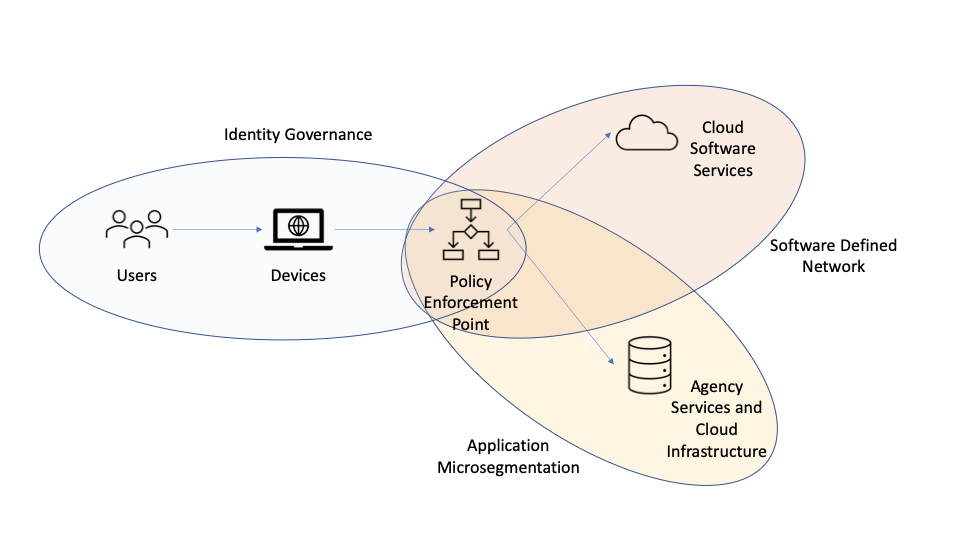

CURRENT STATE APPROACH
- Access to enterprise applications is based on the network location. Enterprise applications hosted in agency data centers usually require users to be on an agency network either directly, through a VPN, or a virtual desktop solution.
- With the increase in remote access and telework, VPNs are highlighted as a potential single point of failure if on-premise VPN infrastructure can not sustain the high traffic volume. Many agency services are media forms (video conferencing, video training, youtube, or skillport videos), which are also a high consumer of bandwidth. The high volume is a bandwidth chokepoint.
- This use case relies on configuration management & monitoring of devices on the network regardless of whether the enterprise owns them.
ZERO TRUST OBJECTIVE
- The intent is to use the internet, at scale and capacity, without throttling access through on-premise appliances and provide security and compliance for government traffic.
- This use case assumes an enterprise user is attempting to access agency resources that traditionally required either a VPN or connection to an agency network. Under a zero-trust approach, the IT enterprise has deployed tools to accomplish the following:
- Device compliance.
- Centralized access point with gateway access to on-premise applications or centralized access point to cloud applications.
- Advanced use cases may include limiting user capabilities, such as allowing upload and download from a GFE device while blocking upload and download on a BYOD device.
VALUE PROPOSITION FROM ZERO TRUST APPROACH
- Leverage internet scale, capacity, and services and only steer traffic to on-premise as necessary.
- Eliminate heavy bandwidth traffic from clogging VPN infrastructure. Split traffic VPN is an option that also comes with administrative overhead in maintaining a split traffic list and existing agency capacity.
- Understand each user and their connections. A zero-trust approach allows an enterprise to observe and evaluate each device's current state as part of evaluating the access request process.
- CDM asset management /software asset management allows for configuration, survey, and update with physical and network location.
WHERE TO GET STARTED
- An identity management system that supports federation.
- Identify pilot applications that support single sign-on that is not an HVA.
- Identify a small group of users to test application access.
- Identify a policy enforcement point that either is an identity management system or integrates with an identity management system.